By 2027, Kenyans will once again walk into polling stations carrying their hopes, frustrations and expectations for a better country. But perhaps there is one question we should all be asking before we vote: Are we electing leaders who want to build Kenya, or leaders who have mastered the business of benefiting from its destruction?
There are documentaries you watch, discuss for a few hours and eventually forget. Then there are documentaries that leave you questioning everything you thought you understood about your country.
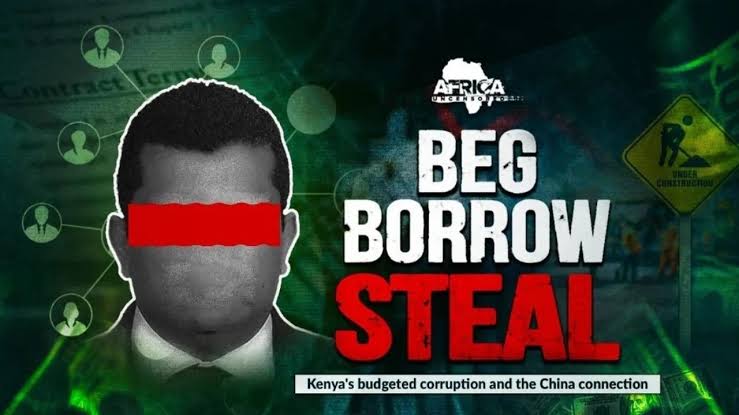
John-Allan Namu's latest investigative documentary, Beg, Borrow, Steal: Kenya's Budgeted Corruption and The China Connection, by Africa Uncensored, belongs to the latter category.
It is not simply a story about corruption. It is a disturbing examination of how public borrowing, infrastructure development, questionable financial transactions and alleged networks of corruption can intersect to rob a country of its future.
And with the 2027 General Election approaching, Kenyans cannot afford to treat these revelations as just another political controversy.
1. When development becomes an opportunity for theft
For years, Kenyans have been told that borrowing is necessary for development.
We borrow to build roads, expand ports, improve transport systems and modernise infrastructure. In principle, there is nothing wrong with borrowing if the investment generates economic value, improves people's lives and creates opportunities for future generations.
But what happens when money borrowed in the name of development is allegedly diverted through questionable financial arrangements?
Namu's investigation examines alleged financial schemes involving major infrastructure projects, including the Nairobi Western Bypass, Nairobi Expressway and Kipevu Oil Terminal.
The documentary draws on whistleblower testimony, banking records and tax investigations to expose an alleged network involving shell companies, questionable invoices and the movement of money connected to infrastructure financing.
One of the most disturbing aspects is the alleged use of innocent Kenyans' identity documents and KRA PINs to establish companies that were reportedly used in questionable transactions.
Think about that for a moment.
An ordinary Kenyan, possibly struggling to find employment or establish a small business, could have their identity exploited in financial dealings they know absolutely nothing about.
This is no longer just about money disappearing from government accounts. It raises questions about institutional accountability, financial oversight and the protection of citizens.
2. The China connection: We must ask difficult questions
The documentary also examines the involvement of China Road and Bridge Corporation (CRBC) and its parent company, China Communications Construction Company (CCCC).
Let us be clear: China's involvement in Kenya's infrastructure development is not automatically evidence of wrongdoing. International partnerships, foreign investment and infrastructure financing can contribute significantly to economic development.
The issue is whether such partnerships operate within transparent, accountable and mutually beneficial arrangements.
When billions are borrowed, contracts awarded and projects implemented, Kenyans have a right to know:
- How much money was borrowed?
- Who negotiated the agreements?
- Were contracts awarded competitively?
- Was the full scope of the contracted work delivered?
- Who verified the work and authorised payments?
- Who takes responsibility when public money cannot be accounted for?
These are not anti-China questions. They are pro-Kenya questions.
The documentary raises serious allegations that deserve independent investigation, institutional scrutiny and appropriate legal action where evidence supports it.
A country cannot claim to be pursuing economic independence while failing to protect its own resources.
3. The real cost of corruption is not just the money stolen
Sometimes we discuss corruption as though it is simply about billions disappearing from government accounts.
But corruption has a human cost.
Consider a road project that is funded through public borrowing but does not deliver all the infrastructure promised. The missing components may mean unsafe pedestrian crossings, inadequate lighting and preventable accidents.
Consider a water project whose budget is inflated or whose implementation is compromised. Somewhere, a community may continue walking kilometres in search of clean water.
Consider a hospital whose allocated funds are mismanaged. Somewhere, a patient may be unable to access essential medical services.
And consider the young Kenyan graduating from university, applying for jobs and struggling to establish a livelihood while the country continues servicing debts accumulated in the name of development.
The money stolen from public projects is money that could have improved someone's life.
Even more troubling, the debt does not simply disappear when a project fails to deliver. The taxpayer remains responsible for repayment.
We could end up paying for development twice: once through the money lost to corruption and again through the taxes used to repay the borrowing.
That is the intergenerational cost of corruption.
4. 2027 should not be another popularity contest
This is where I believe the documentary becomes particularly relevant to our political future.
As we approach the 2027 General Election, political conversations will become louder. We will see rallies, promises, political alliances, defections, colourful campaigns and leaders presenting themselves as the solutions Kenya desperately needs.
But how many Kenyans will take time to examine the financial integrity of the people seeking public office?
How many will ask their preferred presidential candidate about public debt, procurement accountability and the management of public resources?
How many will interrogate the records of their governors, senators, MPs and MCAs?
We cannot continue electing leaders based solely on their ability to mobilise crowds, distribute handouts, deliver entertaining speeches or demonstrate political connections.
Leadership is not a popularity competition.
A leader's ability to mobilise millions for a political rally does not necessarily demonstrate their ability to manage millions of public money.
And a politician who promises to build roads, hospitals and schools must also explain how those projects will be financed, implemented, monitored and audited.
In 2027, we must begin looking beyond campaign promises and examine leadership records.
5. Your vote is also a financial decision
There is something we often overlook when discussing elections.
When you elect a president, governor or legislator, you are not simply choosing someone to represent your political interests. You are entrusting that individual with influence over decisions involving public finances.
You are giving them a role in determining how taxes are collected, how budgets are approved, how contracts are scrutinised and how public resources are distributed.
This makes voting a financial decision as much as it is a political one.
Before electing someone in 2027, ask:
1. Integrity: What is their record concerning public resources and accountability?
2. Competence: Do they understand the responsibilities of the office they are seeking?
3. Transparency: Are they willing to disclose their interests, explain their decisions and answer difficult questions?
4. Accountability: Have they demonstrated responsibility when things go wrong?
5. Vision: Do they have realistic plans for employment, healthcare, education, infrastructure and economic growth?
6. Public service: Are they seeking office to serve citizens or to gain access to public resources?
We must also stop rewarding politicians simply because they belong to our political camps.
A bad decision does not become a good decision because it was made by our preferred leader.
And corruption does not become acceptable because the person implicated speaks our language, comes from our community or supports our political party.
Kenya belongs to all of us.
6. We must also protect those who speak out
Another important dimension of Namu's documentary is the danger faced by whistleblowers and investigative journalists.
The investigation describes threats against individuals involved in exposing the alleged financial schemes. It also highlights the importance of safeguarding evidence through the SafeBox Network of Forbidden Stories.
This raises an uncomfortable question: What happens to a country when exposing possible corruption becomes dangerous?
A functional democracy needs journalists who can investigate those in power, whistleblowers who can report wrongdoing and institutions capable of protecting them.
We cannot demand accountability while remaining silent when those pursuing it are threatened.
Investigative journalism should not replace the work of law enforcement, Parliament, auditors or the judiciary. But it can expose questions that these institutions must investigate.
And when credible evidence emerges, the response should be investigation, not intimidation.
7. The 2027 question: What kind of Kenya are we voting for?
Perhaps the most important lesson from Beg, Borrow, Steal is that corruption is not always visible.
Sometimes it wears a suit and sits in a boardroom. Sometimes it appears in a beautifully presented development project. Sometimes it hides behind complicated contracts, financial transactions and institutions that ordinary citizens may never understand.
By the time the consequences become visible, the money may already be gone, the contracts completed and the debt transferred to future generations.
This is why Kenyans must become more politically conscious and financially informed.
We need voters who understand national budgets, public debt, procurement and the responsibilities of elected leaders.
We need young people who are interested in more than political trends and personalities.
We need communities that can question their elected representatives long after election campaigns are over.
Most importantly, we need leaders who understand that public money is not personal wealth and public office is not an investment opportunity.
My biggest concern going into 2027 is not simply who will win the election. It is whether we, as voters, will have learnt enough to make better choices.
We cannot keep complaining about the cost of living, unemployment, public debt and failing public services while ignoring the quality and integrity of the people we entrust with power.
We cannot demand accountability from government while giving our preferred politicians a free pass.
And we cannot keep sacrificing the future of our children for the temporary excitement of political campaigns.
My final thought
John-Allan Namu and the Africa Uncensored team have given Kenyans something important: an opportunity to ask difficult questions about how public money is handled.
But watching a documentary is not enough.
Sharing it on WhatsApp is not enough. Arguing about it on X is not enough. Blaming one political administration and defending another is not enough.
The real test will be what we do with the information.
As we approach 2027, let us scrutinise the people seeking our votes. Let us interrogate their records, question their promises and demand accountability regardless of political affiliation.
Because the person you elect in 2027 may determine not just the Kenya you live in today, but the Kenya your children will inherit tomorrow.
Perhaps this time, we should vote with our eyes open.