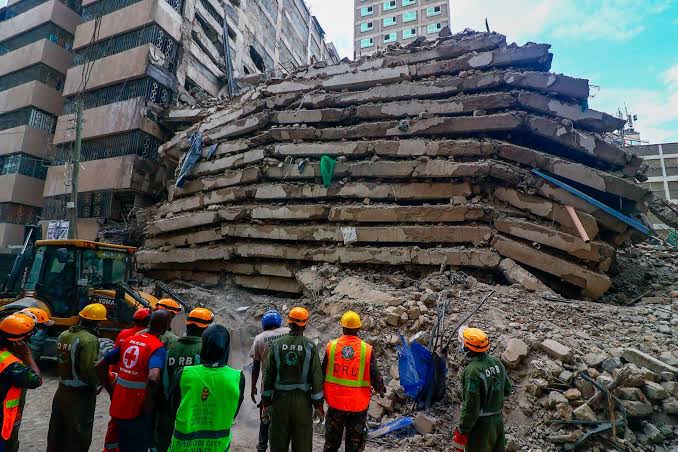
When tragedy strikes, politicians are often among the first to arrive at the scene. But as the Eastleigh building collapse raises questions about public safety and accountability, Kenyans must ask whether these visits translate into meaningful action or simply provide another opportunity for political visibility.**
The collapse of a building in Eastleigh, Nairobi, has once again brought the country's construction safety standards, regulatory enforcement and political accountability into the spotlight. As rescue operations continue and questions emerge about how such a tragedy could happen, the presence of political leaders at the scene has sparked a familiar debate: Are our leaders genuinely concerned about the people they represent, or are they using moments of tragedy to build their political profiles?
It is a difficult question, particularly when people may still be trapped beneath rubble, families are waiting for news of their loved ones, and business owners are facing the loss of their livelihoods. At such a moment, the immediate priority should be saving lives and supporting those affected. Yet disasters rarely happen in isolation from politics, especially in a country where public safety, government oversight and leadership are constantly under scrutiny.
When Disaster Meets Politics
Following the Eastleigh building collapse, several political leaders visited the scene or publicly commented on the incident. Nairobi Governor Johnson Sakaja visited the site, while other leaders, including Wiper leader Kalonzo Musyoka, Nairobi Senator Edwin Sifuna and Kiharu MP Ndindi Nyoro, expressed concern and called for accountability.
Former Nairobi County Chief Officer Geoffrey Mosiria also attracted attention during his visit, with reports describing residents chanting his name and referring to him as a governor amid his declared interest in the Nairobi gubernatorial seat in 2027.
These appearances raise questions about the relationship between public service and political ambition. When a politician arrives at a disaster scene, is the primary objective to help coordinate assistance, demand answers or demonstrate solidarity with affected residents? Could it be a combination of these motivations?
It would be unfair to assume that every politician who visits a disaster scene is pursuing publicity. Leaders have a responsibility to respond to emergencies, listen to affected communities and ensure that relevant authorities act. Their presence can also draw attention to neglected problems and increase pressure for a response.
However, it is equally reasonable for citizens to question whether public concern is being converted into political advantage, particularly when the incident attracts extensive media coverage and public attention.
The challenge is distinguishing between legitimate leadership and political performance. A visit alone cannot establish a person's motives. What matters is what the leader contributes, what responsibilities they accept and what happens after the cameras leave.
The Bigger Question: How Did the Building Collapse?
While political appearances have attracted attention, the more fundamental issue is why the building collapsed in the first place.
Reports following the incident raised questions about construction approvals and regulatory enforcement. Governor Sakaja stated that the building's construction plans had not been approved, although an application for a change of use had previously been approved. The full circumstances and causes of the collapse require investigation, and responsibility should not be assigned without evidence.
Nevertheless, the incident raises serious questions about the systems intended to protect residents and workers.
Construction safety depends on several safeguards, including approved building plans, competent engineering professionals, proper supervision, compliance with structural standards and regular inspections. These measures are intended to identify dangerous practices before they result in loss of life.
If a building can be constructed or occupied without the required approvals and adequate oversight, the consequences extend far beyond the developer. Construction workers, traders, customers, neighbouring residents and passers-by can all be exposed to danger.
This is why the Eastleigh tragedy must not become merely another political argument. It should prompt a transparent examination of the approvals process, inspections, enforcement decisions and any warnings that may have been ignored.
The public deserves to know what happened, which institutions were responsible for oversight and whether any failures contributed to the collapse.
Are Politicians Using the Tragedy for Publicity?
Political visibility is an unavoidable part of public leadership. When disasters occur, leaders are expected to communicate with citizens, coordinate their institutions and demonstrate that they understand the public's concerns. Their actions may naturally attract media attention.
The problem arises when visibility becomes a substitute for responsibility.
A politician can issue a strong statement, visit the scene and promise investigations, yet the affected families may still struggle to obtain support. A leader can criticise an opponent's administration while overlooking failures within institutions they influence. Another can demand accountability today but abandon the issue when public attention shifts elsewhere.
These possibilities deserve scrutiny, but they should not be treated as established facts about any particular leader without supporting evidence.
The most useful way to assess political sincerity is to examine conduct over time. Did the leader help facilitate an effective emergency response? Did they support the affected families? Did they cooperate with investigators? Did they demand the publication of findings? Did they follow up on recommendations intended to prevent another collapse?
These questions are more revealing than photographs, speeches or the number of people gathered around a politician.
The 2027 Election Factor
With Kenya moving towards the 2027 General Election, public appearances can carry additional political significance. Issues such as housing, infrastructure, service delivery and public safety are likely to feature in conversations about leadership, particularly in Nairobi.
For an aspiring politician, a highly publicised disaster may provide an opportunity to demonstrate concern for residents and highlight weaknesses in existing systems. That does not automatically make the response insincere. An aspiring leader can have genuine concerns while also seeking public recognition.
The important distinction is whether political ambition supports meaningful action or overshadows the needs of the people affected.
Voters should therefore pay attention to more than what politicians say during emergencies. They should examine their records, the policies they support, the problems they have addressed and the commitments they fulfil.
A leader who speaks passionately about unsafe buildings should also be prepared to explain how they would improve inspections, strengthen enforcement, protect construction workers and ensure that developers comply with the law.
The same standards should apply to elected officials and those seeking office.
What Should Happen After the Cameras Leave?
The Eastleigh building collapse should lead to concrete measures rather than disappear from public discussion once another news story emerges.
First, the relevant authorities should conduct a credible investigation and communicate their findings transparently. The investigation should establish the technical cause of the collapse and determine whether regulatory, professional or construction failures contributed to it.
Second, Nairobi's building inspection and enforcement systems should be examined. Where serious safety risks are identified, the authorities should take lawful and timely action, including stopping dangerous construction and addressing violations.
Third, affected families, injured people and displaced traders should receive appropriate assistance. Emergency response should be followed by clear communication about available support and the steps being taken to address their immediate needs.
Finally, any officials, professionals or developers found responsible for misconduct or negligence should face appropriate consequences through established legal and professional processes.
These actions would provide a meaningful measure of leadership because they would help address the causes and consequences of the disaster rather than simply its public image.
Conclusion: Judge Leadership by What Remains After the Tragedy
So, are politicians genuinely concerned when disasters strike, or are they using tragedy for attention?
The answer cannot be established simply by observing who visited Eastleigh or who received the loudest public welcome. Different leaders may have different motivations, and genuine concern can coexist with political ambition. What matters is whether their actions serve the public interest and whether their commitments produce tangible results.
For the families affected by the collapse, political competition offers little comfort without answers, assistance and accountability. For Nairobi residents, the incident is a reminder that public safety must be protected before buildings fall, not debated only after lives are placed at risk.
As Kenya approaches another election, citizens have an opportunity to demand a higher standard of leadership. Politicians should be judged not only by their response to a crisis but also by their commitment to preventing the next one.
A politician's visit to a disaster scene may attract attention, but lasting leadership is demonstrated by the lives protected, the failures corrected and the promises fulfilled long after the cameras have gone.