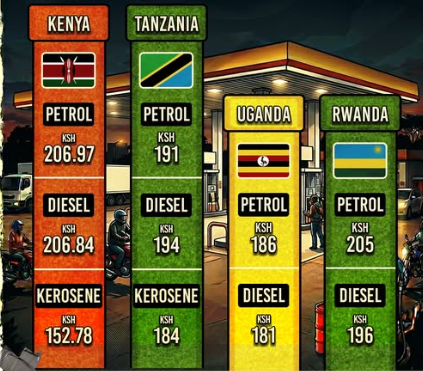

By the time fuel prices go up, the effects are already on their way to the matatu stage, the market, the supermarket and the family kitchen.
Kenyans are facing another increase in fuel prices after the Energy and Petroleum Regulatory Authority (EPRA) announced new pump prices for the period running from October 15 to November 14, 2026. In Nairobi, super petrol rose by KSh 12.93 per litre to KSh 226.96, diesel increased by KSh 9.90 to KSh 227.76, while kerosene recorded a steeper increase of KSh 28.49 to KSh 219.87 per litre. These are the maximum permitted retail prices. Source: EPRA.
The increases come amid rising international petroleum import costs linked to tensions and conflict in the Middle East. For a country that relies heavily on imported petroleum products, developments thousands of kilometres away can quickly become a concern for ordinary Kenyans.
But beyond the figures released by EPRA, there is a more pressing question: How much more pressure can Kenyan households take?
When Fuel Prices Rise, Everything Feels the Impact
Fuel is not just a concern for motorists. It is an essential input in the movement of people, food and goods across the country.
When diesel becomes more expensive, transport operators face higher operating costs. Traders pay more to move produce from farms to markets, while manufacturers and delivery businesses must find ways to manage their rising expenses.
Eventually, some of these costs may be passed on to consumers.
For a worker who uses a matatu every day, even a small fare increase can make a difference over a month. For a parent already struggling to balance rent, food, school fees and other bills, higher transport costs leave less money for other necessities.
The situation is especially concerning for households that depend on kerosene for cooking and lighting. With kerosene recording the largest per-litre increase in the latest review, these families face additional pressure on already limited budgets.
Why Is Fuel Becoming More Expensive?
International oil prices are an important part of the explanation. Conflict and insecurity in major oil-producing regions can disrupt supply chains, increase shipping risks and push up the cost of petroleum products.
The exchange rate also matters. Since petroleum imports are priced in foreign currency, fluctuations in the value of the Kenyan shilling can affect the amount importers pay.
Taxes, transportation, storage and other costs also form part of the regulated pump-price calculation.
This means that the latest increase cannot be explained by a single factor. EPRA's pricing framework takes several costs into account when determining the maximum retail prices for each monthly cycle.
Nevertheless, Kenyans deserve clear explanations of these calculations. When prices rise, the public should be able to understand what has changed, which costs have increased and what measures, if any, are available to cushion consumers.
Matatu Operators and Commuters: Who Should Carry the Burden?
The latest increase has renewed concerns within the public transport sector. The Matatu Owners Association has warned that higher fuel costs could lead to increased fares, arguing that operators are struggling with other expenses, including vehicle maintenance, insurance and spare parts.
Operators have legitimate business costs to consider. However, commuters also have financial limits.
A transport operator cannot indefinitely absorb rising costs without affecting the sustainability of the business. At the same time, commuters cannot keep paying higher fares without making sacrifices elsewhere.
This creates a difficult balance between keeping transport businesses operational and ensuring that ordinary citizens can still afford to travel to work, school and essential services.
The government, transport stakeholders and consumer representatives need to engage constructively before the burden becomes even more difficult for households to manage.
Should the Government Intervene?
Calls for government intervention are understandable, but any proposed solution must consider both immediate relief and long-term sustainability.
Temporary tax adjustments or targeted support could help cushion consumers during exceptional price shocks. However, such measures have fiscal costs, and broad subsidies can become difficult to sustain if international prices remain high.
Greater transparency in fuel pricing is equally important. Citizens need to understand the relationship between international import costs, taxation and the final pump price.
The government should also examine how best to protect vulnerable households and essential services without creating unsustainable public expenditure.
The goal should not simply be to announce temporary relief whenever prices rise. It should be to develop a more resilient energy system that reduces the country's exposure to international petroleum market shocks.
Can Kenya Reduce Its Dependence on Imported Fuel?
This is where the conversation needs to move beyond the monthly price announcement.
Kenya has opportunities to reduce its vulnerability through investment in renewable energy, efficient public transport and cleaner technologies.
Expanding reliable electric public transport, supporting electric motorcycles and improving urban transport planning could gradually reduce petroleum consumption in parts of the transport sector.
In agriculture, solar-powered irrigation and efficient water-pumping systems could reduce reliance on diesel-powered equipment. Businesses can also improve energy efficiency to limit the effects of fuel-price fluctuations on their operating costs.
These changes require investment, reliable infrastructure, affordable financing and effective implementation. They will not eliminate the need for petroleum overnight, but they can help reduce the economy's exposure to future shocks.
Energy security should therefore be treated as an economic priority, not merely an environmental ambition.
The Bigger Question for Kenya
Every fuel-price increase forces Kenyans to adjust their budgets. But repeatedly asking households to absorb higher costs cannot be the country's only response.
The latest price review is a reminder that Kenya remains vulnerable to developments in international energy markets. It also presents an opportunity to examine whether enough is being done to improve public transport, support vulnerable households, strengthen transparency and accelerate alternatives to imported petroleum.
The government must balance the realities of global oil markets with the everyday needs of citizens. Transport operators must remain financially viable, businesses must continue operating, and households must be able to afford basic necessities.