For nearly four years, the economic conversation in Kenya has carried a familiar refrain: "the government inherited a broken economy."
The Kenya Kwanza administration has repeatedly pointed to the debt, fiscal pressures and economic difficulties it inherited when President William Ruto took office in September 2022. Government officials have argued that the administration inherited an economy constrained by heavy debt obligations, high inflation and limited fiscal space.
There is truth in that argument.
But as Kenya moves closer to the 2027 General Election, another question is becoming increasingly difficult to avoid:
Is the blame game still working?
More importantly, what has the ordinary mwananchi gained from the argument over who is responsible for the country's economic difficulties?
The government did inherit a difficult economy
It is important to begin with the facts rather than political rhetoric.
When the previous administration ended its term, Kenya's gross public debt stood at approximately KSh8.59 trillion at the end of June 2022. Debt had already become a major concern, with debt service consuming significant government resources.
That means the Ruto administration did not inherit an empty government account and a clean balance sheet.
The country had significant obligations to meet, including domestic and external debt repayments. The effects of COVID-19, the Russia-Ukraine war, global inflation and other international shocks had also placed pressure on economies around the world.
Therefore, dismissing the government's argument entirely would be unfair.
Kenya's economic problems did not begin in 2022.
But neither did they end in 2022.
The question changes once you take office
This is where the political debate becomes more complicated.
When a new administration takes over, it inherits both the problems and the responsibility to govern.
It can explain what it found.
It can investigate previous decisions.
It can prosecute wrongdoing where there is evidence.
It can restructure government priorities.
But eventually, the public expects results.
The Ruto administration has now been in office for almost four years. At this point, the question for many Kenyans is no longer simply:
"Who caused the economic problem?"
It is increasingly:
"What has this government done about it?"
That is a fair question for any government, regardless of political affiliation.
The economy is growing but are households feeling it?
There are positive indicators that should not be ignored.
Kenya's real GDP grew by 4.6% in 2025, according to the Kenya National Bureau of Statistics (KNBS), with all sectors recording positive growth. In the first quarter of 2026, the economy grew by 5.3%, compared with 4.9% in the corresponding quarter of 2025.
These figures matter.
They suggest that the Kenyan economy is not collapsing and that economic activity continues to expand.
But GDP growth is not the same thing as household prosperity.
A country can experience economic growth while many households continue struggling with food prices, transport costs, rent, taxes and unemployment.
For the mwananchi, the economic question is often much simpler:
"After paying all my bills, do I have more money left than I did before?"
The cost-of-living question
The latest inflation figures illustrate why economic statistics can feel very different from everyday life.
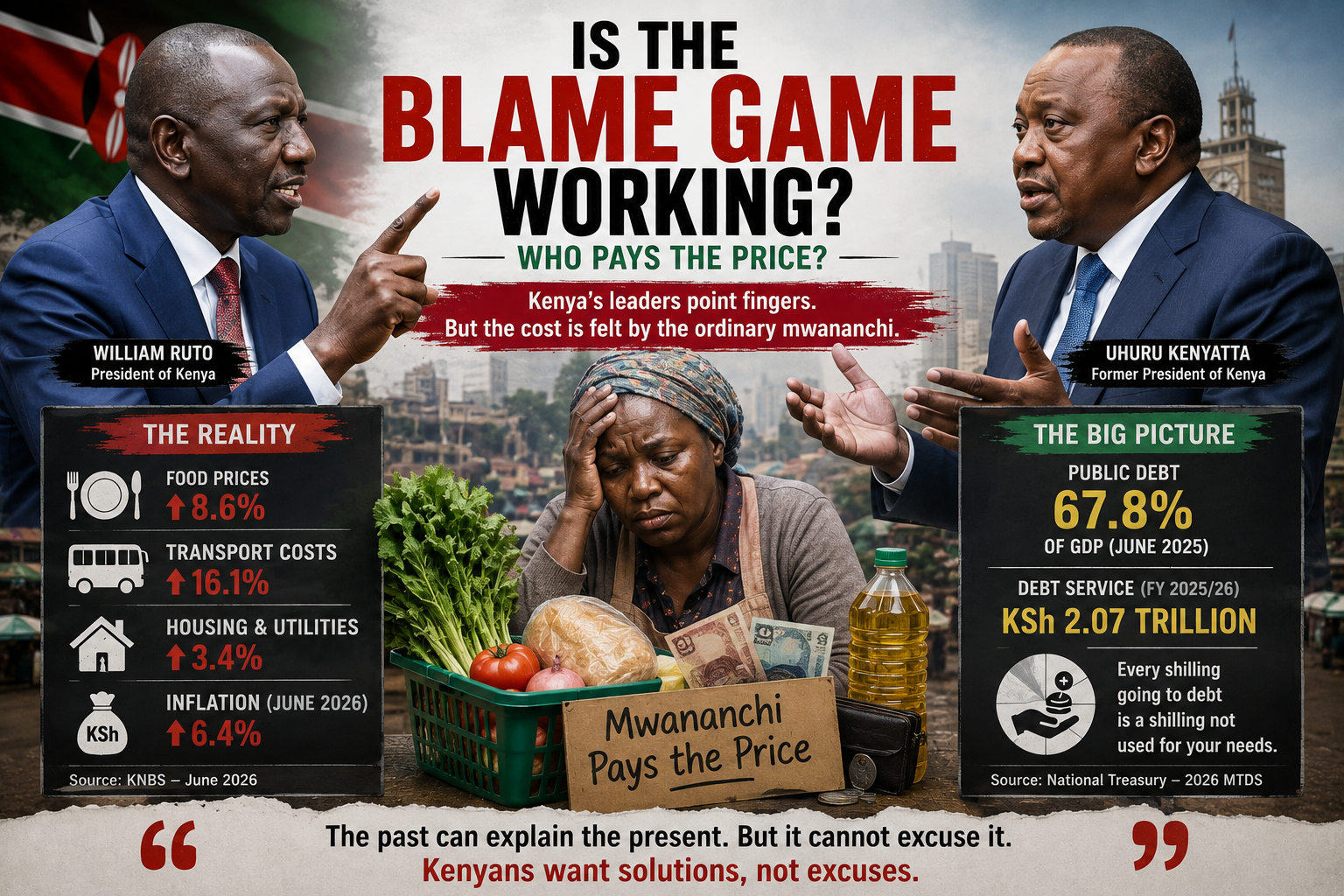
KNBS reported annual inflation of 6.4% in June 2026. Food and non-alcoholic beverages rose by 8.6%, while transport costs increased by 16.1%. Housing, water, electricity, gas and other fuels rose by 3.4% over the same period.
Those percentages have real consequences.
For a low-income household, food is not an optional expense.
Transport is not an optional expense for someone travelling to work.
Electricity is not an optional expense for a family trying to keep children studying.
And water is certainly not an optional expense.
This is where the economic debate leaves Parliament and State House and enters the kitchen.
The mwananchi does not experience GDP primarily as a percentage.
They experience it as the price of unga, fare to work, rent at the end of the month, school fees, electricity tokens and the amount remaining in their M-Pesa account.
Taxes have made the debate even more politically sensitive
The government's attempt to raise revenue has been one of the most contentious parts of its economic strategy.
The administration has argued that increased taxation is necessary to reduce borrowing and finance government programmes.
There is an economic rationale behind that argument.
A government cannot continually borrow to finance its operations without eventually facing serious fiscal consequences.
But taxation also has a cost.
In 2024, proposed tax increases triggered widespread protests, with demonstrators arguing that additional taxes would increase the cost of living. The Finance Bill was eventually withdrawn after intense public opposition.
This episode demonstrated something important:
economic policy is not simply about what looks good on a Treasury spreadsheet.
It is also about what citizens can realistically absorb.
Kenya's debt problem remains
There is another uncomfortable part of the conversation.
The government inherited substantial debt, but the debt burden remains substantial under the current administration.
According to the National Treasury's 2026 Medium-Term Debt Management Strategy, Kenya's nominal public debt stood at 67.8% of GDP at the end of June 2025, up from 65.7% a year earlier. Treasury also identified the country's debt burden as high and noted rising domestic interest costs.
The Treasury's 2024/25 debt report projected total debt-service requirements of approximately KSh2.07 trillion for FY2025/26.
This is where the issue becomes directly relevant to ordinary Kenyans.
Money used to service debt cannot simultaneously be used for every other government priority.
The government therefore faces a difficult choice between:
borrowing more, taxing more, cutting expenditure, or finding ways to grow the economy faster than the debt burden.
None of these options is painless.
So, is the blame game working?
The answer depends on what we mean by "working."
Politically?
To some extent, yes.
The government has a legitimate narrative: it inherited a difficult fiscal position and has been forced to make unpopular decisions to stabilise the economy.
That argument resonates with some Kenyans.
But there is a limit to how long it can remain persuasive.
Economically?
No.
Blaming a previous administration does not reduce the national debt.
It does not lower food prices.
It does not create jobs.
It does not reduce the cost of transport.
It does not make healthcare more affordable.
And it does not increase the purchasing power of a struggling household.
For the mwananchi?
This is perhaps the most important test.
If citizens continue to feel poorer or financially squeezed, explanations about what happened before 2022 will eventually become less important to them.
The public will want to know what is happening now.
But the opposition should not get an easy pass either
There is a danger of turning this discussion into a simplistic "government bad, opposition good" narrative.
The opposition would inherit the same debt if it took power.
It would inherit the same infrastructure commitments, the same wage bill, the same debt repayments and the same revenue constraints.
It would also have to decide whether to borrow, tax, cut expenditure or reform government spending.
The economic problem therefore transcends individual politicians.
Kenya's challenge is structural.
The country needs stronger productivity, better public financial management, more private-sector investment, productive employment, efficient taxation and disciplined borrowing.
Changing the person sitting in State House does not automatically change those fundamentals.
The real cost of the blame game
Perhaps the greatest cost is not financial.
It is lost time.
Every year spent arguing about who inherited what is another year in which Kenyans want answers on jobs, affordable food, healthcare, education, housing, water, infrastructure and the cost of doing business.
The previous administration should be held accountable for its decisions.
The current administration should also be held accountable for its own.
And any future administration should face the same scrutiny.
Accountability cannot be selective.
The mwananchi is ultimately the referee
There is a temptation in politics to measure success through speeches, rallies, economic statistics or political popularity.
But the ordinary Kenyan has a different scorecard.
Can I afford food?
Can I find work?
Can I pay my rent?
Can I afford transport?
Can I access healthcare without selling something to pay the bill?
Can my business survive?
Can I educate my children?
These are not opposition questions.
They are not UDA questions.
They are not ODM questions.
They are Kenyan questions.
Kenya's economy has made progress in some areas, and the government deserves recognition where its policies have produced measurable improvements. At the same time, the persistent pressure on household budgets and the country's substantial debt burden deserve serious scrutiny.
The country therefore needs something more useful than a permanent argument over who broke the economy.
It needs a serious conversation about how to fix it.
Beyond "Who did it?"
The 2027 election will inevitably turn the economy into a political battlefield.
The government will point to what it inherited and what it has achieved.
The opposition will point to the cost of living, taxation, debt and government spending.
Both sides will have statistics.
Both sides will have explanations.
But perhaps the most important voice will belong to the person who does not sit in Parliament.
The farmer.
The boda boda rider.
The teacher.
The small trader.
The young graduate looking for work.
The parent paying school fees.
The family buying food at the market.
They may not care who inherited the debt.
They may simply want to know:
"Has my life become better?"
That is where the blame game will ultimately be judged.
Because governments are elected to inherit problems and solve them.
The past can explain the present.
But it cannot permanently excuse it.
The Kenya Kwanza administration has repeatedly pointed to the debt, fiscal pressures and economic difficulties it inherited when President William Ruto took office in September 2022. Government officials have argued that the administration inherited an economy constrained by heavy debt obligations, high inflation and limited fiscal space.
There is truth in that argument.
But as Kenya moves closer to the 2027 General Election, another question is becoming increasingly difficult to avoid:
Is the blame game still working?
More importantly, what has the ordinary mwananchi gained from the argument over who is responsible for the country's economic difficulties?
The government did inherit a difficult economy
It is important to begin with the facts rather than political rhetoric.
When the previous administration ended its term, Kenya's gross public debt stood at approximately KSh8.59 trillion at the end of June 2022. Debt had already become a major concern, with debt service consuming significant government resources.
That means the Ruto administration did not inherit an empty government account and a clean balance sheet.
The country had significant obligations to meet, including domestic and external debt repayments. The effects of COVID-19, the Russia-Ukraine war, global inflation and other international shocks had also placed pressure on economies around the world.
Therefore, dismissing the government's argument entirely would be unfair.
Kenya's economic problems did not begin in 2022.
But neither did they end in 2022.
The question changes once you take office
This is where the political debate becomes more complicated.
When a new administration takes over, it inherits both the problems and the responsibility to govern.
It can explain what it found.
It can investigate previous decisions.
It can prosecute wrongdoing where there is evidence.
It can restructure government priorities.
But eventually, the public expects results.
The Ruto administration has now been in office for almost four years. At this point, the question for many Kenyans is no longer simply:
"Who caused the economic problem?"
It is increasingly:
"What has this government done about it?"
That is a fair question for any government, regardless of political affiliation.
The economy is growing but are households feeling it?
There are positive indicators that should not be ignored.
Kenya's real GDP grew by 4.6% in 2025, according to the Kenya National Bureau of Statistics (KNBS), with all sectors recording positive growth. In the first quarter of 2026, the economy grew by 5.3%, compared with 4.9% in the corresponding quarter of 2025.
These figures matter.
They suggest that the Kenyan economy is not collapsing and that economic activity continues to expand.
But GDP growth is not the same thing as household prosperity.
A country can experience economic growth while many households continue struggling with food prices, transport costs, rent, taxes and unemployment.
For the mwananchi, the economic question is often much simpler:
"After paying all my bills, do I have more money left than I did before?"
The cost-of-living question
The latest inflation figures illustrate why economic statistics can feel very different from everyday life.
KNBS reported annual inflation of 6.4% in June 2026. Food and non-alcoholic beverages rose by 8.6%, while transport costs increased by 16.1%. Housing, water, electricity, gas and other fuels rose by 3.4% over the same period.
Those percentages have real consequences.
For a low-income household, food is not an optional expense.
Transport is not an optional expense for someone travelling to work.
Electricity is not an optional expense for a family trying to keep children studying.
And water is certainly not an optional expense.
This is where the economic debate leaves Parliament and State House and enters the kitchen.
The mwananchi does not experience GDP primarily as a percentage.
They experience it as the price of unga, fare to work, rent at the end of the month, school fees, electricity tokens and the amount remaining in their M-Pesa account.
Taxes have made the debate even more politically sensitive
The government's attempt to raise revenue has been one of the most contentious parts of its economic strategy.
The administration has argued that increased taxation is necessary to reduce borrowing and finance government programmes.
There is an economic rationale behind that argument.
A government cannot continually borrow to finance its operations without eventually facing serious fiscal consequences.
But taxation also has a cost.
In 2024, proposed tax increases triggered widespread protests, with demonstrators arguing that additional taxes would increase the cost of living. The Finance Bill was eventually withdrawn after intense public opposition.
This episode demonstrated something important:
economic policy is not simply about what looks good on a Treasury spreadsheet.
It is also about what citizens can realistically absorb.
Kenya's debt problem remains
There is another uncomfortable part of the conversation.
The government inherited substantial debt, but the debt burden remains substantial under the current administration.
According to the National Treasury's 2026 Medium-Term Debt Management Strategy, Kenya's nominal public debt stood at 67.8% of GDP at the end of June 2025, up from 65.7% a year earlier. Treasury also identified the country's debt burden as high and noted rising domestic interest costs.
The Treasury's 2024/25 debt report projected total debt-service requirements of approximately KSh2.07 trillion for FY2025/26.
This is where the issue becomes directly relevant to ordinary Kenyans.
Money used to service debt cannot simultaneously be used for every other government priority.
The government therefore faces a difficult choice between:
borrowing more, taxing more, cutting expenditure, or finding ways to grow the economy faster than the debt burden.
None of these options is painless.
So, is the blame game working?
The answer depends on what we mean by "working."
Politically?
To some extent, yes.
The government has a legitimate narrative: it inherited a difficult fiscal position and has been forced to make unpopular decisions to stabilise the economy.
That argument resonates with some Kenyans.
But there is a limit to how long it can remain persuasive.
Economically?
No.
Blaming a previous administration does not reduce the national debt.
It does not lower food prices.
It does not create jobs.
It does not reduce the cost of transport.
It does not make healthcare more affordable.
And it does not increase the purchasing power of a struggling household.
For the mwananchi?
This is perhaps the most important test.
If citizens continue to feel poorer or financially squeezed, explanations about what happened before 2022 will eventually become less important to them.
The public will want to know what is happening now.
But the opposition should not get an easy pass either
There is a danger of turning this discussion into a simplistic "government bad, opposition good" narrative.
The opposition would inherit the same debt if it took power.
It would inherit the same infrastructure commitments, the same wage bill, the same debt repayments and the same revenue constraints.
It would also have to decide whether to borrow, tax, cut expenditure or reform government spending.
The economic problem therefore transcends individual politicians.
Kenya's challenge is structural.
The country needs stronger productivity, better public financial management, more private-sector investment, productive employment, efficient taxation and disciplined borrowing.
Changing the person sitting in State House does not automatically change those fundamentals.
The real cost of the blame game
Perhaps the greatest cost is not financial.
It is lost time.
Every year spent arguing about who inherited what is another year in which Kenyans want answers on jobs, affordable food, healthcare, education, housing, water, infrastructure and the cost of doing business.
The previous administration should be held accountable for its decisions.
The current administration should also be held accountable for its own.
And any future administration should face the same scrutiny.
Accountability cannot be selective.
The mwananchi is ultimately the referee
There is a temptation in politics to measure success through speeches, rallies, economic statistics or political popularity.
But the ordinary Kenyan has a different scorecard.
Can I afford food?
Can I find work?
Can I pay my rent?
Can I afford transport?
Can I access healthcare without selling something to pay the bill?
Can my business survive?
Can I educate my children?
These are not opposition questions.
They are not UDA questions.
They are not ODM questions.
They are Kenyan questions.
Kenya's economy has made progress in some areas, and the government deserves recognition where its policies have produced measurable improvements. At the same time, the persistent pressure on household budgets and the country's substantial debt burden deserve serious scrutiny.
The country therefore needs something more useful than a permanent argument over who broke the economy.
It needs a serious conversation about how to fix it.
Beyond "Who did it?"
The 2027 election will inevitably turn the economy into a political battlefield.
The government will point to what it inherited and what it has achieved.
The opposition will point to the cost of living, taxation, debt and government spending.
Both sides will have statistics.
Both sides will have explanations.
But perhaps the most important voice will belong to the person who does not sit in Parliament.
The farmer.
The boda boda rider.
The teacher.
The small trader.
The young graduate looking for work.
The parent paying school fees.
The family buying food at the market.
They may not care who inherited the debt.
They may simply want to know:
"Has my life become better?"
That is where the blame game will ultimately be judged.
Because governments are elected to inherit problems and solve them.
The past can explain the present.
But it cannot permanently excuse it.