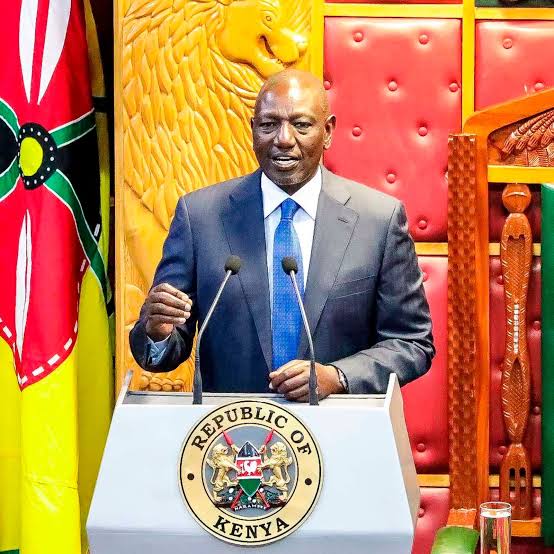

President William Ruto's fourth State of the Nation Address, delivered on Wednesday, 18 November 2026, was more than a constitutional obligation. It was a political statement, a defense of his administration's four-year record and, perhaps most importantly, an opportunity to make his case to Kenyans ahead of the 2027 General Election.
With approximately nine months remaining before Kenyans return to the ballot, the President stood before Parliament with a clear message: Kenya is making progress, his administration has delivered, and the country's economic direction is improving.
But outside Parliament, that message was not received with one voice.
The address exposed a familiar but increasingly important divide in Kenyan politics: the difference between what the government considers progress and what ordinary citizens consider meaningful improvement.
According to reports from Parliament, government-aligned legislators praised the President's performance, while sections of the opposition boycotted the address and questioned its credibility.
1. A President defending his record, not just presenting the state of the nation
One of the strongest features of Ruto's address was its emphasis on economic recovery.
The President pointed to the strengthening of the Kenyan shilling, increased foreign exchange reserves, reduced commercial lending rates and progress in infrastructure, agriculture, education and healthcare.
He presented these indicators as evidence that difficult economic decisions were beginning to produce results.
His argument was straightforward: Kenya inherited serious economic challenges in 2022, but the administration has made progress in stabilizing the economy and expanding development.
There is merit in examining these figures. Economic stability matters. A stronger currency can reduce the cost of imports, while lower lending rates can make borrowing more accessible to businesses.
However, economic performance cannot be judged exclusively through national statistics.
A stronger shilling does not automatically mean a household can afford rent. Lower inflation does not necessarily mean food is affordable. And an expanding economy does not automatically translate into decent employment for young people.
This is where the President's message faces its biggest test: translating macroeconomic achievements into improvements that citizens can actually feel.
2. The opposition's boycott: protest or missed opportunity?
Perhaps one of the most politically significant developments surrounding the address was the absence of sections of the opposition.
Leaders associated with Wiper, DCP and the Linda Mwananchi movement boycotted the proceedings.
Nairobi Senator Edwin Sifuna dismissed the speech as self-praise, arguing that the President was not adequately addressing the challenges facing ordinary Kenyans, particularly concerns about abductions and human rights.
Wiper leader Kalonzo Musyoka also criticized the address, linking it to the experiences of victims of the Gen Z protests.
Their position raises an important question: what should Parliament priorities when the President delivers an account of the country's progress?
The opposition has a legitimate responsibility to scrutinize government performance, challenge questionable claims and demand accountability.
However, there is also a political cost to absence.
By boycotting the address, opposition leaders surrendered an opportunity to challenge the President's claims directly within Parliament and present an alternative interpretation of the country's progress.
In politics, silence can communicate dissatisfaction, but it can also surrender the platform to your opponent.
The opposition must therefore move beyond rejecting the government's narrative and demonstrate what it would do differently.
3. The Gen Z question: Has the government addressed the wounds of 2024?
One cannot analyze this address without revisiting the June 2024 Gen Z protests and the subsequent demonstrations that challenged the administration.
During his speech, President Ruto acknowledged the deaths, injuries, trauma and destruction associated with the protests. He reaffirmed the constitutional right to peaceful demonstrations under Article 37 and stated that security officers who use unlawful force must be held accountable.
He also cited a Sh2 billion allocation towards compensation for victims of human rights violations.
This was an important acknowledgement. However, acknowledging a problem and resolving it are two different things.
For families who lost loved ones, young people who suffered injuries and citizens who continue to demand accountability, compensation alone cannot substitute for justice.
The real test will be whether investigations lead to accountability, whether victims receive justice and whether citizens can express dissatisfaction without fear.
The youth question remains politically sensitive. Young Kenyans are not simply looking for speeches that recognise their frustrations. They want institutions that listen, employment opportunities, economic inclusion and a government that respects their constitutional rights.
The government may have moved forward politically, but has it moved forward in rebuilding public trust? That is a question the President cannot answer through economic statistics alone.
4. The economic debate: Numbers versus the cost of living
Perhaps the biggest contradiction surrounding the address is the relationship between economic recovery and household financial pressure.
The President highlighted improvements in the exchange rate, inflation and lending rates. These are important indicators, and dismissing them entirely would be unfair.
However, Kenyans experience the economy differently.
A young graduate searching for employment does not measure economic recovery through foreign exchange reserves. A mother struggling to provide three meals a day does not necessarily feel economic progress because the shilling has strengthened.
A small business owner wants affordable credit, customers with purchasing power and a predictable tax environment.
Even the public debt question remains difficult to ignore. The Standard reported that Kenya's public debt had reached approximately KSh13.47 trillion by the end of August 2026, raising questions about fiscal sustainability and how much government revenue is consumed by debt servicing.
The issue, therefore, is not whether Kenya has made economic progress. It is whether that progress is reaching enough households to make a meaningful difference.
5. Parliament's applause versus the public's verdict
Inside Parliament, the atmosphere was largely celebratory among government supporters. Chants of Tutam and Usawa ni Sawa accompanied the proceedings, while government-aligned MPs praised the President's record.
Some legislators described the address as comprehensive, factual and reflective of the country's development trajectory.
On the other hand, opposition leaders questioned its credibility, with Sifuna describing it as a presentation that ignored the realities facing ordinary citizens.
The contrast is politically revealing.
However, it is important not to confuse parliamentary reactions with the opinion of the entire country. Applause from MPs does not establish nationwide approval, just as criticism from opposition politicians does not establish nationwide rejection.
The public response reported so far is mixed, and a representative opinion poll would be needed to establish the actual level of public support.
There is also a bigger question: what did Kenyans take away from the speech?
Did they hear a President who has delivered on his promises, or a President who is asking for more time to complete his agenda?
Did they see a government that understands their financial struggles, or one that is more comfortable presenting national statistics than confronting everyday realities?
These are the questions that will shape the political conversation long after the parliamentary proceedings have ended.
6. The 2027 factor: Was this also an early campaign message?
It would be politically naïve to examine this address without considering its timing.
With the 2027 General Election approaching, Ruto is entering a period where every government achievement, every policy decision and every public appearance carries political significance.
The speech provided him with an opportunity to remind Kenyans of his 2022 promises and present his administration's achievements as reasons to renew his mandate.
The repeated emphasis on development, economic recovery and equitable distribution of resources was not just an account of government performance. It was also an argument for political continuity.
The opposition, meanwhile, has an opportunity to build its campaign around the gaps between government promises and citizens' experiences.
But here is the challenge for both sides: Kenyans need more than political slogans.
The government must demonstrate measurable results, while the opposition must offer credible alternatives rather than simply campaigning against the incumbent.
In 2027, political loyalty alone may not be enough. Voters will increasingly want to know what has changed in their lives and what each candidate intends to do differently.
My political assessment: Ruto has made his case, but has he convinced the country?
President Ruto delivered a speech that was strategically important, politically calculated and focused on defending his administration's record.
He highlighted genuine areas of economic and infrastructural progress, acknowledged difficult national issues and attempted to position his administration as one steering Kenya towards recovery.
However, his biggest challenge is not necessarily convincing Parliament. It is convincing the Kenyan public.
There is a difference between having an impressive national development report and having a population that feels the benefits of development.
There is also a difference between acknowledging public dissatisfaction and restoring public confidence.
As we approach 2027, I believe the political conversation should move beyond who delivered the better speech.
We should be asking harder questions:
- Are young people finding meaningful employment?
- Is the cost of living becoming manageable for ordinary households?
- Are victims of human rights violations receiving justice?
- Are public resources translating into better services?
- Can the government demonstrate that development is reaching every region and not just appearing in political announcements?
Ultimately, the State of the Nation should not be measured by how loudly Parliament applauds the President. It should be measured by the lived experiences of the people whose lives government policies are supposed to improve.
Ruto has presented his scorecard. The opposition has rejected it. But the most important assessment is still pending: the verdict of the Kenyan voter in 2027.